Wednesday, April 22, 2009
Exoplanet transit of the star Sirius
Here is a project I did in povray. It makes use of media and a simple disc to simulate the sun. The planets look like they are lit by the sun, but simply have a gradient texture to simulate the color patterns you'd get on a planet.
BTW, this is just an artistic simulation, not the real thing, in case you were wondering. :)


Tuesday, April 21, 2009
Antarctic ice data proves global warming hoax?
I saw a conservative in a religious forum post a news article that he said disproved a manmade connection to global warming. He even touted the honesty and reliability of the particular scientists involved in this story, compared to the general population of scientists working on climate change. Let's see.
In the news.com.au story, Antarctic ice is growing, not melting away, by Greg Roberts, we read:
Okay, there you have it. Dr. Ian Allison , a scientist at the Australian Antarctic Division, is an inherently reliable scientist. What is his opinion on climate change?
He's interviewed in the Reuters story, Q+A: How great is the threat from melting ice sheets?
There you have it. An inherently reliable scientist says that the IPCC "conclusviely showed that a major cause of warming is greenhouse gas emissions from mankind.
In the news.com.au story, Antarctic ice is growing, not melting away, by Greg Roberts, we read:
"Australian Antarctic Division glaciology program head Ian Allison said sea ice losses in west Antarctica over the past 30 years had been more than offset by increases in the Ross Sea region, just one sector of east Antarctica.
"Sea ice conditions have remained stable in Antarctica generally," Dr Allison said.
Okay, there you have it. Dr. Ian Allison , a scientist at the Australian Antarctic Division, is an inherently reliable scientist. What is his opinion on climate change?
He's interviewed in the Reuters story, Q+A: How great is the threat from melting ice sheets?
Ian Allison is leader of the Australian Antarctic Division's Ice, Ocean, Atmosphere and Climate program and a researcher within the Antarctic Climate and Ecosystems Cooperative Research Center.
He has been involved in Antarctic science for over 40 years.
HOW GREAT IS THE THREAT FROM ICE SHEETS MELTING?
"I think it is now unequivocal that warming of the world is occurring and I think the last IPCC (Intergovernmental Panel on Climate Change) conclusively showed that a major cause of warming is greenhouse gas emissions from mankind.
There you have it. An inherently reliable scientist says that the IPCC "conclusviely showed that a major cause of warming is greenhouse gas emissions from mankind.
Monday, April 20, 2009
Why my 3D work impresses so few people.
It's because it's so 1991. Here's an animation I found at the SIGGRAPH archive at archive.org.
Sunday, April 19, 2009
A Dailymotion "Video Wall"
This shows the videos I've submitted to Dailymotion. I guess I haven't put many things up there.
Saturday, April 18, 2009
Long-necked turtles
I took this footage at the National Zoo in DC. I thought it was interesting how these turtles moved, both their legs and necks.
Friday, April 17, 2009
The Relativity Train
I created this animation for the TC-RTC
raytracing competition. Unfortunately, I was the only entry for this round, which is "Relativity." I made an animation which tries to show the humorous consequences of the speed of light being constant across all frames of reference. A superhero blasts two robots aboard a train moving near the speed of light. Onboard observers observe them being blasted simultaneously. Stationary observers observe one being blasted first. Only this time there are diplomatic consequences for Earth!
If you're interested in the animation at all, go to the Vimeo page and see it full screen!
The Relativity Train from pterandon on Vimeo.
raytracing competition. Unfortunately, I was the only entry for this round, which is "Relativity." I made an animation which tries to show the humorous consequences of the speed of light being constant across all frames of reference. A superhero blasts two robots aboard a train moving near the speed of light. Onboard observers observe them being blasted simultaneously. Stationary observers observe one being blasted first. Only this time there are diplomatic consequences for Earth!
If you're interested in the animation at all, go to the Vimeo page and see it full screen!
The Relativity Train from pterandon on Vimeo.
Friday, April 10, 2009
How to accelerate and decelerate masses for character animation in povray
Oftentimes in making character animation, I've received or heard criticisms about wooden, unrealistic movement. In many 3D applications, it is very easy to make a character move to and fro. The temptation is usually to make the "curve" look like a sawtooth. The character's body part (arm, leg, hand, etc.) moves in one direction for a while and then suddenly reverses in an instant. In most 3D apps, you have the option of tweaking the curves. Problem is, it's quite tedious in the more advanced 3D apps, and not at all obvious how to do in povray.
Note the animation below. The character on the left moves in the stereotypical "sawtooth" fashion. The acceleration and deceleration are instantaneous. The next one has a little more acceleration, increasing up to the fifth one. The sixth character moves in a sin curve fashion.
The way I derived these equations was to integrate x to the n times one minus x to the n. I did this for 1, 2, 3, and 4. The result of these integrations is shown in the formulas below.

I hope this will help someone in povray at some time.
Note the animation below. The character on the left moves in the stereotypical "sawtooth" fashion. The acceleration and deceleration are instantaneous. The next one has a little more acceleration, increasing up to the fifth one. The sixth character moves in a sin curve fashion.
The way I derived these equations was to integrate x to the n times one minus x to the n. I did this for 1, 2, 3, and 4. The result of these integrations is shown in the formulas below.

I hope this will help someone in povray at some time.
Sunday, March 29, 2009
Why local newspapers are in trouble
The chairs of the Chambers of Commerce of two nearby counties are appearing on TV ads around here. They are stressing the importance for me to buy local, because buying local keeps local jobs here. The two counties represented a very wide region. Presumably, the businessman from the county further away from me would want me to buy products from his county, even if it didn't meet my other concerns in the marketplace, such as price, value, quality, sustainable manufacturing processes, labor issues, etc. If he's going to appeal to my self-interest, it doesn't work, because I don't want to get a job which requires a one-hour commute to the far corner of that other county. The appeal doesn't resonate with me at all.
I think the same problem happens with local or regional news outlets, whether it be radio or print. Yes, it's probably pretty hard for these outlets to compete with international news organizations in providing detailed coverage of international events. Thus, they concentrate on "local news." The problem as I see it is that they, like the Chambers of Commerce described above, really want me to care deeply about folks within a 90 mile region of my home, but practically draw a line in the sand at that border. They stress the importance of international news by telling me how it affects people within 90 miles of my home.
Case in point. I remember during American involvement in the Bosnia War, it seemed as though there were more coverage of local residents returning as soldiers from the war than the causes and effects of the war itself. It's like, "You should care about Bosnia, because someone 90 miles away from you had to go fight in it." (Frankly speaking, if the guy lived on the other side of the river from me, what makes him so special? I cared about that war because humans had to fight and because humans suffered in it, not because of its effects on inhabitants of some artificial boundary drawn at the subscriber base of the paper.)
A baseball player had a drug scandal. The front page of my local paper had headlines: local fans react! The lifestyle section had a long article about how someone born 90 miles from my house had worked with some of the music business' hottest stars! My public radio station's news reporting seemed to follow the same ambulance chasing-- it's important because it affected someone in our region.
To a similar degree, the same thing happened with NBC's coverage of women's Olympic volleyball matches. NBC showed us every single instance of the American ladies' touching their hair, but we barely saw the faces of the international women they played against.
I tried to express the problem in graphical form below. I'm guessing the average Joe has more concern for his family than for the huddled masses of faraway countries, with concern dropping off steadily as the persons become more distant. I myself probably have a twisted sense of interest, in that my geographical patriotism stops at the borders of my school district, but I have a great concern for the poor of the planet. The local and regional news outlets, however, have a degree of coverage that doesn't match either of our interest curves. That is why I believe they are financially in trouble. I've not noticed when my local paper subscription expired, I've lost interest in supporting the news programs of local public radio.

Don't get me wrong. I deeply care about what happens to the country, I want it to prosper. But my interest-curve is that I want the country to do right and be well because of the effect it has on my family and the huddled masses of the planet, NOT exclusively because of the effect it has on folks 90 miles away from me. I think the long term economic and security interest of my nation, my family, and those 90 miles away from me lies in the overall degree of misery on the planet. Stated another way, I find that a lifeboat philosophy to be not only immoral but ultimately self-defeating in terms of seeking self-interest.
Regardless of your political views about "the market", ultimately businesses have to meet the demands of the market, or die. I propose that there is a disconnect between the coverage focus of local media and the actual interests of consumers. I wonder if the coverage model they've adopted has to do with following the wrong-headed advice of "focus groups" rather than common sense.
Here's my proposal for their success. The local media outlets may continue to send out reporters only within their traditional 90-mile radius. But they have to change the approach to their coverage completely. Instead of reporting on how local residents have been affected by or played a hand in international events, they need to show how local events have an international impact. Imagine if you were to take an American history professor from China, a French labor activist, and an African manufacturer, and sent them to rural upstate New York. Tell them that they have to fill up an hour (or a few pages ) of copy on things that happened in that little town on that day that would be of interest to the world. That is a paper I'd surely miss if my subscription were to run out.
Think globally, report locally, is my proposal for newspaper success.
ADDENDUM (04/02):
The reporting in my local paper underscored this problem all the more poignantly recently. There was a special election for a seat in the U.S. House of Representatives in New York's 20th congressional district. The district is an unusually long and twisted one-- you should click on that link to see the map. Anyway, the district apparently covers one county in the readership of my local paper, and many other counties. The paper had an in-depth story comparing the voting results in this election versus the 2008 one. They showed us how, on a town by town basis, the results were different. The only problem was that they ignored all the counties of the 20th district but their own! They seemed to think we were only interested in our own county! If you really wanted to understand the voting demographics as it would have an effect on the representation in congress, I think you'd want to know how all the towns in the district voted. But, no, the local paper's interest stopped at its circulation boundaries. I cannot imagine how many people would have an interest-cliff that would coincide with the paper: either they don't care about towns other than their own, or they might care about a region larger than the congressional district. That is why local papers are dying.
I think the same problem happens with local or regional news outlets, whether it be radio or print. Yes, it's probably pretty hard for these outlets to compete with international news organizations in providing detailed coverage of international events. Thus, they concentrate on "local news." The problem as I see it is that they, like the Chambers of Commerce described above, really want me to care deeply about folks within a 90 mile region of my home, but practically draw a line in the sand at that border. They stress the importance of international news by telling me how it affects people within 90 miles of my home.
Case in point. I remember during American involvement in the Bosnia War, it seemed as though there were more coverage of local residents returning as soldiers from the war than the causes and effects of the war itself. It's like, "You should care about Bosnia, because someone 90 miles away from you had to go fight in it." (Frankly speaking, if the guy lived on the other side of the river from me, what makes him so special? I cared about that war because humans had to fight and because humans suffered in it, not because of its effects on inhabitants of some artificial boundary drawn at the subscriber base of the paper.)
A baseball player had a drug scandal. The front page of my local paper had headlines: local fans react! The lifestyle section had a long article about how someone born 90 miles from my house had worked with some of the music business' hottest stars! My public radio station's news reporting seemed to follow the same ambulance chasing-- it's important because it affected someone in our region.
To a similar degree, the same thing happened with NBC's coverage of women's Olympic volleyball matches. NBC showed us every single instance of the American ladies' touching their hair, but we barely saw the faces of the international women they played against.
I tried to express the problem in graphical form below. I'm guessing the average Joe has more concern for his family than for the huddled masses of faraway countries, with concern dropping off steadily as the persons become more distant. I myself probably have a twisted sense of interest, in that my geographical patriotism stops at the borders of my school district, but I have a great concern for the poor of the planet. The local and regional news outlets, however, have a degree of coverage that doesn't match either of our interest curves. That is why I believe they are financially in trouble. I've not noticed when my local paper subscription expired, I've lost interest in supporting the news programs of local public radio.

Don't get me wrong. I deeply care about what happens to the country, I want it to prosper. But my interest-curve is that I want the country to do right and be well because of the effect it has on my family and the huddled masses of the planet, NOT exclusively because of the effect it has on folks 90 miles away from me. I think the long term economic and security interest of my nation, my family, and those 90 miles away from me lies in the overall degree of misery on the planet. Stated another way, I find that a lifeboat philosophy to be not only immoral but ultimately self-defeating in terms of seeking self-interest.
Regardless of your political views about "the market", ultimately businesses have to meet the demands of the market, or die. I propose that there is a disconnect between the coverage focus of local media and the actual interests of consumers. I wonder if the coverage model they've adopted has to do with following the wrong-headed advice of "focus groups" rather than common sense.
Here's my proposal for their success. The local media outlets may continue to send out reporters only within their traditional 90-mile radius. But they have to change the approach to their coverage completely. Instead of reporting on how local residents have been affected by or played a hand in international events, they need to show how local events have an international impact. Imagine if you were to take an American history professor from China, a French labor activist, and an African manufacturer, and sent them to rural upstate New York. Tell them that they have to fill up an hour (or a few pages ) of copy on things that happened in that little town on that day that would be of interest to the world. That is a paper I'd surely miss if my subscription were to run out.
Think globally, report locally, is my proposal for newspaper success.
ADDENDUM (04/02):
The reporting in my local paper underscored this problem all the more poignantly recently. There was a special election for a seat in the U.S. House of Representatives in New York's 20th congressional district. The district is an unusually long and twisted one-- you should click on that link to see the map. Anyway, the district apparently covers one county in the readership of my local paper, and many other counties. The paper had an in-depth story comparing the voting results in this election versus the 2008 one. They showed us how, on a town by town basis, the results were different. The only problem was that they ignored all the counties of the 20th district but their own! They seemed to think we were only interested in our own county! If you really wanted to understand the voting demographics as it would have an effect on the representation in congress, I think you'd want to know how all the towns in the district voted. But, no, the local paper's interest stopped at its circulation boundaries. I cannot imagine how many people would have an interest-cliff that would coincide with the paper: either they don't care about towns other than their own, or they might care about a region larger than the congressional district. That is why local papers are dying.
Wednesday, March 25, 2009
Ongeluk met raceauto / Crashing racing car
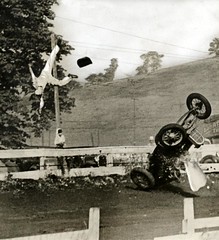
Ongeluk met raceauto / Crashing racing car
Originally uploaded by Nationaal Archief.
This is a pretty wild scene-- a car crash from 1936. The photo was part of the Nationaal Archief of the Netherlands.
The driver apparently was hospitalized only with severe bruises, fortunately.
Friday, March 13, 2009
Copper prices
I'm always fascinated by web gadgets that give information you might not otherwise have. Just recently I was asked whether steel or copper were more expensive. Too bad I didn't have this blog article already written:


Subscribe to:
Posts (Atom)